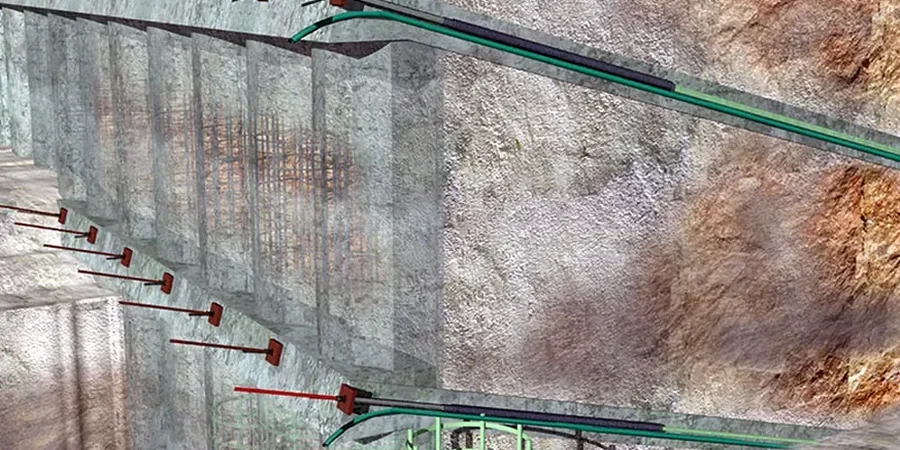
The Detroit River clay that underlies much of Windsor sits on a bedrock valley buried under roughly 30 meters of soft to stiff silty clay. When you excavate more than 4.5 meters in the city center, groundwater becomes an immediate issue, with the water table often found just 2 to 3 meters below grade. We start every anchor design by mapping these specific stratigraphic hazards. A proper tieback anchor system here has to counteract not just the lateral earth pressure but the creeping movement common in the glaciolacustrine deposits. For projects near the riverfront, we also run correlation with in-situ permeability tests to confirm that the grout-to-ground bond won't be compromised by seepage before applying the lock-off load.
A passive anchor in Windsor clay can lose 15% of its bond strength if the borehole isn't flushed properly before grouting. Clean holes are non-negotiable.
Our approach and scope
The drilling rigs we mobilize in Windsor are compact rotary units fitted with duplex drilling capabilities, essential for getting through the fill and into competent clay without collapsing the hole. Each anchor tendon we install is a high-tensile DYWIDAG or Williams bar, typically 15.7 mm strands, encased in corrugated sheathing with factory-applied epoxy coating for the free-stressing length. Load cells and tell-tales are mounted on the waler beams to track performance during the excavation stages. We test every anchor to 133% of the design load per CSA A23.3 standards, and in passive systems like soil nails, we run a sacrificial test nail to verify the bond stress before production drilling begins. The grout mix is adjusted seasonally; our winter blend in Windsor includes a non-chloride accelerator to hit set times even when the ambient temperature drops below minus 10.
Quick answers
Does an active anchor system make sense for a residential basement dig in South Windsor?
Most residential excavations in Windsor are under 4 meters, so a passive soil nail system or even a cantilevered soldier pile wall is often more practical. Active tiebacks become cost-effective when you have a property line constraint and need to keep the excavation open for several months. We can run a quick feasibility check if you share the lot dimensions and neighboring foundation depths.
What is the cost range for an engineered anchor design in Windsor?
For a typical commercial excavation with 30 to 60 active tiebacks, the design, testing oversight, and compliance documentation runs between CA$1,400 and CA$4,830 depending on the number of anchor rows and the complexity of the soil profile. A passive nail design with fewer testing requirements sits at the lower end of that range.
How do you verify the bond strength in the Detroit River clay before production drilling?
We install a sacrificial test anchor at the same inclination and within the same soil unit as the production anchors. It's loaded to 200% of the design load in increments, and we measure creep at each step. If the creep rate exceeds 2 mm per log cycle of time, we adjust the bond length before any production anchor goes in.
Do you handle the permit submission for the shoring design?
Yes, we prepare the sealed design package that the City of Windsor requires for excavation support permits. The package includes the anchor schedule, testing procedure, monitoring plan, and a letter of professional assurance. We coordinate directly with the city's building department on your behalf.
How long does the design and approval process take?
Once we have the geotechnical report and structural loads, a typical anchor design with permit-ready drawings takes 7 to 10 business days. Rush service is available for projects that are already mobilized and need a quick re-design.