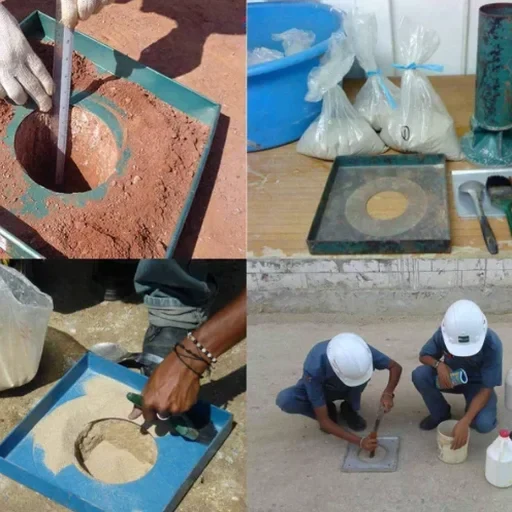
Compaction requirements shift noticeably between Windsor's east and west sides. A residential slab in Forest Glade sits on sandier, drained soils, while a commercial pad near Sandwich Town contends with the remnants of the former Great Marsh: soft, compressible silty clay layers that demand rigorous lift-by-lift verification. The native glacial lake plain deposits, shaped by the recession of Lake Whittlesey some 13,000 years ago, create a patchwork where optimum moisture content and maximum dry density can vary within a single city block. Meeting the Ontario Building Code's compaction thresholds here means the standard Proctor curve is just a starting point; field correlation with a sand cone density test becomes the only way to confirm that what was specified on paper actually translates to the ground. For contractors working within Windsor's 146.9 km² footprint, the difference between a passed and failed lift often traces back to understanding exactly which soil unit they are compacting. We combine local geomorphological knowledge with ASTM D1556 procedures to deliver density results that hold up under scrutiny from municipal inspectors and geotechnical engineers alike.
Windsor's post-glacial clay plain doesn't forgive compaction shortcuts: a 2% density shortfall today becomes a 40 mm differential settlement by the second winter.
Our approach and scope
Windsor's position at 42.3°N latitude creates a freeze-thaw regime that punishes poorly compacted soils: the 100+ freeze-thaw cycles recorded annually by Environment Canada at the Windsor Airport station penetrate deeper into the ground when density is below specification, accelerating pavement distress. The sand cone method, governed by ASTM D1556, remains the practical field standard here because it directly measures in-place density using a calibrated Ottawa sand of known specific gravity, independent of the soil's electrical or nuclear properties that can skew readings in the region's naturally occurring clay mineralogy. A single test provides the wet density, moisture content, and dry density needed to compute percent compaction against the laboratory Proctor curve. For granular fills beneath a
retaining wall along the Detroit River, where granular backfill is essential for drainage, the sand cone's physical volume measurement avoids the oversaturation errors that nuclear gauges can introduce. The process is deliberately methodical: a 150 mm diameter hole is excavated, the extracted soil is sealed immediately to preserve moisture, and the calibrated sand flows from a one-gallon jar through a cone valve into the void. Technicians then calculate the hole volume and derive the in-place wet density from the known sand density. The entire sequence, from surface preparation to result, takes approximately 20 minutes per location, allowing for multiple tests across a lift without halting production. In Windsor's tight clay subgrades where a
plate load test may be specified for bearing capacity, the sand cone density result provides the companion compaction data that the bearing plate test cannot deliver.
Area-specific notes
The National Building Code of Canada references CSA A23.3 for concrete structures, but the soil-structure interface—where compaction failures first manifest—falls under the geotechnical site investigation requirements of Section 4.2. In Windsor, this becomes particularly critical because of the city's lacustrine clay stratigraphy: layers of stiff clay can mask softer, undercompacted pockets that differential settlement will exploit. A sand cone test that reads 98% Proctor at one location means little if pockets at 88% exist three metres away in the same lift. The risk compounds in the Sandwich South and airport area corridors, where the water table in spring routinely rises within 1.5 m of grade, saturating the clay matrix and collapsing the air voids that compaction was meant to eliminate. Without sufficient field density verification, a warehouse floor slab or a storm sewer trench can background post-construction settlement exceeding 50 mm within the first freeze-thaw cycle. We mitigate this by overlaying our sand cone results with Atterberg limits data to confirm that the soil's moisture condition is compatible with the compaction being achieved.
Relevant standards
ASTM D1556 – Standard Test Method for Density and Unit Weight of Soil in Place by Sand-Cone Method, ASTM D698 – Standard Test Methods for Laboratory Compaction Characteristics of Soil Using Standard Effort, ASTM D1557 – Standard Test Methods for Laboratory Compaction Characteristics of Soil Using Modified Effort, OPSS 501 – Ontario Provincial Standard Specification for Compacting, NBCC Division B, Section 4.2 – Geotechnical Site Investigations
Quick answers
What does a sand cone field density test cost in Windsor?
For sites within Windsor and the immediate Essex County area, a single sand cone density test typically falls in the range of CA$150 to CA$170. The exact unit price depends on the number of tests per mobilization and the accessibility of the lift being tested. We supply a consolidated quote based on the compaction plan and the number of lifts requiring acceptance, which usually delivers better value than per-test pricing for multi-day projects.
How many sand cone tests are needed per lift on a typical Windsor commercial site?
The Ontario Building Code references frequency based on fill volume and area; a common benchmark is one test per 300 m² of compacted lift area, with a minimum of three tests per lift for building pads under 1,000 m². In Windsor's variable clay till deposits, we often recommend tightening the spacing to one test per 200 m² in critical structural zones, particularly where the native subgrade transitions from sand to clay within the building footprint.
Can the sand cone method be used in saturated ground conditions near the Detroit River?
The sand cone method requires a stable, dry test hole to function correctly. In Windsor's high-water-table zones—especially within 500 m of the Detroit River shoreline—we dewater the test area or use a temporary casing to prevent sloughing and groundwater inflow. If the soil is fully saturated and the hole collapses, we switch to correlation with a nuclear density gauge or postpone testing until the lift drains. The sand cone method's physical measurement principle means that even minor wall collapse invalidates the volume calculation, so site conditions dictate feasibility.