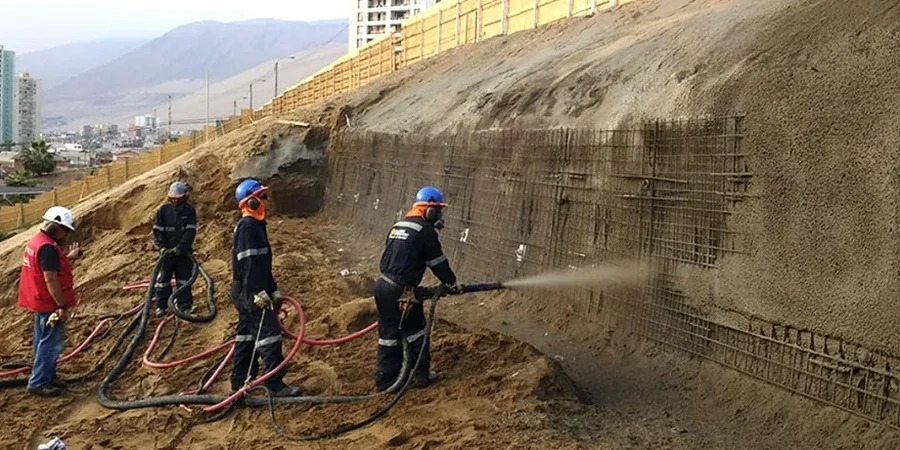
A three-story apartment excavation on Dougall Avenue last spring ran into trouble when the cut face started creeping after 48 hours of rain. The contractor had assumed the native clay till would stand vertical for the duration of foundation work. No site-specific stability model had been run. In Windsor, where the Essex County clay plain meets reworked glacial deposits and the water table sits high across much of the city, that assumption is a liability. We mobilized within the day, mapped the failure surface with a test pit investigation, extracted Shelby tube samples from the intact bench, and calibrated a limit equilibrium model that gave the shoring designer real cohesion and friction angle values. The analysis confirmed a temporary bench angle of 1H:1V was stable—steep enough to keep the project on schedule. Every slope in this region, whether it is a riverbank along the Detroit River or a temporary excavation near Highway 401, needs its own factor of safety computed from field-measured parameters, not textbook defaults.
Windsor's clay plains demand slope models calibrated with site-specific pore pressure data—textbook parameters won't catch a weak seam in the St. Joseph Till.
Relevant standards
Ontario Building Code (OBC) 2012, Division B, Section 4.2 — Foundation requirements including slope stability provisions, NBCC 2020 — National Building Code of Canada, seismic hazard values and geotechnical design references, CSA A23.3-19 — Design of concrete structures, referenced for retaining wall and slope reinforcement design in Ontario, ASTM D1586 — Standard Penetration Test (SPT) for soil sampling referenced in Windsor field programs, ASTM D4767 — Consolidated Undrained Triaxial Compression Test for cohesive soils, used for effective stress strength parameters
Quick answers
What does a slope stability analysis cost for a typical Windsor residential cut?
For a single-lot residential slope in Windsor—say a 4-meter cut for a walkout basement on a riverfront property—the investigation and analysis typically range from CA$1,790 to CA$4,200 depending on access, number of boreholes, and whether piezometers are required. Larger commercial or subdivision slopes, where multiple cross sections and seasonal monitoring are needed, run between CA$4,800 and CA$6,570. Every quote is project-specific and based on the number of field investigation points and analysis sections required.
How does the high water table in Windsor affect slope stability calculations?
A shallow water table reduces effective stress in the slope, which directly lowers shear strength along potential failure surfaces. In Windsor, where the water table can be within 1 to 2 meters of ground surface in spring, we model pore pressure explicitly using piezometer data rather than assuming a simplified phreatic surface. The analysis often shows that the critical condition is not the final slope geometry but the transient condition during a heavy rainfall event, when positive pore pressures develop in the upper weathered zone of the till.
Do I need a slope stability analysis for a temporary construction excavation?
Yes, if the excavation is deeper than 1.2 meters and workers will enter it, Ontario Regulation 213/91 (Construction Projects) requires a competent person to assess soil stability. A formal analysis with a documented factor of safety is the defensible way to meet that requirement. We regularly prepare temporary slope designs for sewer and foundation excavations across Windsor, specifying maximum cut heights, bench widths, and stand-up times based on the soil conditions encountered.
What factor of safety does the Ontario Building Code require for permanent slopes?
The OBC does not state a single number—it requires the designer to select a factor of safety appropriate for the consequence of failure. In practice, for permanent slopes supporting occupied structures or public infrastructure in Windsor, we design to a minimum long-term factor of safety of 1.5 under drained conditions. For temporary construction slopes with no adjacent structures, 1.3 is typically accepted. These values align with the Canadian Foundation Engineering Manual recommendations and are consistently accepted by City of Windsor plan reviewers.