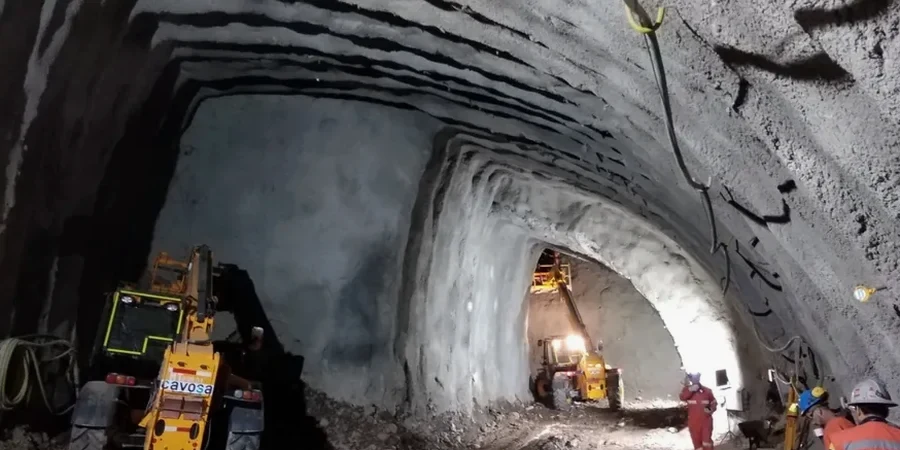
The most common mistake we see in Windsor's tunneling sector is assuming that the stiff near-surface clay will continue at depth. It rarely does. A project near Walker Road last year encountered a pocket of saturated, organic silt at 8 meters—material so soft it barely registered on a pocket penetrometer. The contractor had skipped a detailed soft ground tunnel analysis, relying instead on basic borehole logs from an adjacent property. The resulting face instability set the schedule back three weeks and required a full redesign of the initial support system. Windsor sits on a complex sequence of glacial lake deposits—clays, silts, and sands from the former Lake Whittlesey and Lake Warren shorelines—and predicting their behavior under excavation demands more than standard correlations. Our team approaches each tunnel alignment by first mapping the stratigraphic transitions that define the local geology, then selecting testing protocols that capture the undrained response of these sensitive soils before a single shovelful of earth is removed.
In Windsor's glacial lake clays, the difference between a stable tunnel face and a running ground condition often comes down to whether the silt seams were mapped before the TBM entered the zone.
Area-specific notes
A recent case involved a microtunnel drive beneath a century-old brick sewer on Wyandotte Street East. The alignment passed through a lens of loose alluvial sand at 6.5 meters, fully saturated and only marginally above the hydrostatic head of the Detroit River system. During the pilot bore, the face began to ravel, and groundwater inflow carried fines into the excavation faster than the dewatering wells could manage. Within two hours, surface settlement exceeded 40 millimeters, triggering emergency utility checks and a temporary road closure. What saved the operation was the instrumentation array specified months earlier: vibrating wire piezometers tracking pore pressure decay, in-place inclinometers measuring lateral deformation at the springline, and a surface settlement grid aligned with the crown projection. By correlating real-time data with the pre-construction finite element model—calibrated using triaxial CIU tests on Shelby tube samples—the engineering team adjusted the face pressure and slurry mix mid-drive. The takeaway in Windsor's soft ground is that deep excavation monitoring and staged depressurization are not optional add-ons; they are the primary line of defense against progressive collapse when tunneling through multi-aquifer glacial sequences.
Relevant standards
NBCC 2020 – Division B, Part 4 (structural design, including excavation and foundation provisions), CSA A23.3:2019 – Design of concrete structures (relevant for tunnel linings and shafts), ASTM D4767 – Standard Test Method for Consolidated Undrained Triaxial Compression Test for Cohesive Soils, ASTM D5778 – Standard Test Method for Electronic Friction Cone and Piezocone Penetration Testing of Soils, OPSS.MUNI 206 (Ontario Provincial Standard Specification) – Grading, Excavation and Embankment
Quick answers
What is the range of costs for a geotechnical analysis of a soft ground tunnel alignment in Windsor?
The investment for a comprehensive site investigation and analysis along a typical tunnel alignment in Windsor generally falls between CA$5,840 for a preliminary desk study with limited CPT soundings, and CA$26,250 for a full-scale program that includes multiple deep borings, triaxial and oedometer laboratory testing, and a calibrated 2D/3D finite element model. The final figure depends on the length of the alignment, the number of geotechnical units encountered, and the depth of the tunnel crown.
How do you handle the risk of running ground in Windsor's silty sand lenses during TBM excavation?
Running ground conditions in Windsor's glaciolacustrine deposits are typically associated with loose, saturated silty sand layers interbedded within the softer clay matrix. We map these lenses using CPTu pore pressure dissipation tests and, where warranted, install a pressurized face TBM with active slurry or earth pressure balance control. Pre-treatment by permeation grouting from the surface is also an option when the lens is within 10 meters of grade. The key is detecting the continuity of the lens; isolated pockets behave very differently from interconnected sand channels that communicate with the Detroit River hydraulically.
Which laboratory tests are essential for soft ground tunnel analysis in the Windsor area?
The absolute minimum includes consolidated-undrained (CIU) triaxial tests with pore pressure measurement to define the undrained shear strength profile, and incremental oedometer tests to determine the constrained modulus and the preconsolidation pressure. For the organic silts common in Windsor's filled depressions, we add loss-on-ignition testing and index properties (Atterberg limits and grain size distribution) to classify the soil according to the USCS system. When time-dependent settlement is a concern—for example, under future residential loads above the tunnel—we run a staged oedometer test with creep increments to capture secondary compression coefficients.
How does the seasonal freeze-thaw cycle in Windsor influence tunnel design and construction?
Windsor experiences frost penetration to about 1.2 meters below grade during an average winter, which affects the upper weathered crust of the glaciolacustrine clays. Frozen ground is stiffer and less permeable, which can temporarily improve face stability in shallow tunnel sections. However, the spring thaw brings a sharp increase in pore water pressure and a reduction in effective stress, often triggering delayed settlement or localized softening at the crown. We adjust the design by applying a seasonal reduction factor to the undrained shear strength in the upper 3 meters of the model and by scheduling critical open-face operations for the drier months of July through September whenever the project timeline allows.