← Home · Foundations

Raft/Mat Foundation Design for Windsor Ontario Clay Soils

Together, we solve the challenges of tomorrow.

LEARN MORE →

Windsor sits at an elevation of just 190 meters, right where the Detroit River cuts through a basin of some of the most unpredictable clay soils in southern Ontario. With a population pushing 230,000, the city keeps expanding, and that means more projects on lots where traditional footings simply can't handle the load. Our team deals with this every day—when the water table sits barely a meter down and the upper crust of silty clay gives way to softer varved deposits, a raft/mat foundation design becomes the practical solution, not just a textbook concept. We've seen how the seasonal freeze-thaw cycles here, combined with the river's influence on groundwater, create a profile that demands a floating foundation approach. Getting the grain-size distribution right upfront tells us exactly what we're working with before we commit to reinforcement layouts.

A properly designed raft in Windsor clay doesn't just support the structure—it floats the entire building over the weak lenses that would otherwise cause differential settlement.

Our approach and scope

The high humidity coming off the Detroit River and Lake St. Clair means our clay soils rarely dry out, which keeps them in a plastic to semi-fluid state for most of the construction season. Designing a raft foundation in Windsor is about balancing stiffness against flexibility—the mat has to be rigid enough to bridge over soft spots but flexible enough to accommodate some long-term consolidation without fracturing. We typically run consolidation tests to estimate settlement under the design load and then use finite element analysis to position reinforcement where the bending moments actually occur. The Atterberg limits data is crucial here because the plasticity index of Windsor clay often exceeds 30%, putting it firmly in the high-shrink-swell category despite the constant moisture. Our lab processes samples from across Essex County, and the variability even within a single site can be startling.
Raft/Mat Foundation Design for Windsor Ontario Clay Soils
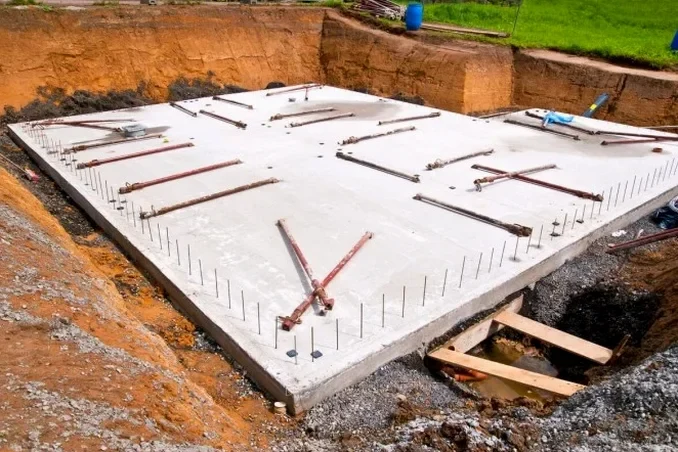
Technical reference image — Windsor Ontario

Local considerations

The mistake we see contractors make in Windsor is treating a mat foundation like an oversized slab-on-grade and skipping the detailed settlement analysis. The soil isn't uniform—there are pockets of organic silt from old riverbeds scattered across neighborhoods like Walkerville and Sandwich. One project we reviewed had to be torn out because the designer assumed a uniform bearing capacity of 150 kPa without verifying the soil profile. The reality is that Windsor's glaciolacustrine clays can lose strength dramatically when disturbed, and a poorly designed raft will tilt toward the weakest pocket. Calling for a CPT test before design gives us a continuous profile of tip resistance and sleeve friction, identifying those soft lenses that boreholes might miss. Getting this wrong means cracked partitions, binding doors, and an expensive remediation down the road.

Need a geotechnical assessment?

Reply within 24h.

Email: info@geotechnicalengineering.vip

Typical values

ParameterTypical value
Typical Net Bearing Pressure50–100 kPa (based on site investigation)
Modulus of Subgrade Reaction (kₛ)5–15 MPa/m (varies with plasticity index)
Maximum Predicted Settlement< 25 mm total, < 15 mm differential
Soil Plasticity Index (Windsor Clay)25–45% (high plasticity zone)
Groundwater Table Depth0.8–2.5 m below grade (seasonal fluctuation)
Reinforcement Yield Strength400R or 500R (CSA G30.18)
Concrete Strength ClassC-2 (CSA A23.1) exposure class C-1 or F-1

Associated technical services

01

Subsurface Investigation for Raft Design

We execute boreholes, CPT soundings, and test pits across your Windsor site to map the stratigraphy of the clay basin. Shelby tube samples go straight to our lab for consolidation and triaxial testing.

02

Settlement and Bearing Capacity Analysis

Using CFEM methods and numerical modeling, we calculate immediate and consolidation settlement under your building loads, accounting for Windsor's high water table and the compressibility of the native clay.

03

Reinforcement and Thickness Optimization

We provide recommended mat thickness, rebar schedules, and construction joint locations based on the actual soil-structure interaction, avoiding the over-conservative assumptions that inflate your concrete budget.

Relevant standards

NBCC 2020 (Part 4 – Structural Design), CSA A23.3:19 (Design of Concrete Structures), Canadian Foundation Engineering Manual (CFEM 4th Edition), Ontario Building Code (OBC) with Windsor amendments

Frequently asked questions

What does a raft/mat foundation design cost in Windsor?

For a typical residential or light commercial project in Windsor, the geotechnical investigation and mat foundation design package runs between CA$1,460 and CA$5,470. The range depends on the number of boreholes required, the depth of investigation, and whether we need to run advanced lab tests like consolidation or triaxial compression on the clay samples.

How deep do you need to investigate for a mat foundation in Windsor?

We typically extend the investigation to a depth of at least twice the width of the mat, or until we hit a competent bearing stratum. In Windsor, that often means going 10 to 15 meters down to get past the soft upper clay and into the stiffer glacial till, which gives us the data we need for settlement calculations using the stress bulb method from the CFEM.

Can a raft foundation eliminate the need for piles in Windsor clay?

In many cases, yes. A properly designed raft distributes the building load over a large enough area to keep bearing pressures low enough for the native clay. We run the numbers on total and differential settlement first—if we can keep both within the NBCC limits without going to deep foundations, the raft is often the more economical choice for the site.

How long does the design process take from investigation to final report?

Fieldwork on a standard Windsor lot takes one to two days. Lab testing on the clay samples—consolidation, Atterberg, and strength tests—runs about two to three weeks because consolidation tests require incremental loading and pore pressure dissipation. The design report, including settlement predictions and reinforcement recommendations, is typically in your hands four weeks after we mobilize the drill rig.
Location and service area

We serve projects in Windsor Ontario and surrounding areas.

View larger map