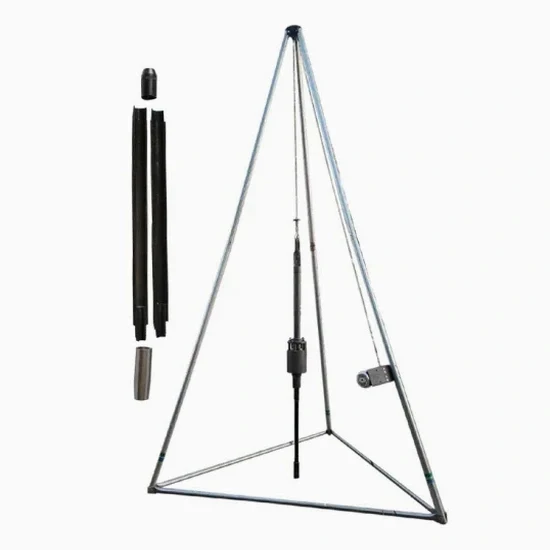
Windsor sits at roughly 190 meters above sea level on a flat plain composed of glacial lake deposits and ancient river sediments. The soil profile here can change dramatically within a few meters, a reality that has shaped every major construction project from the Ambassador Bridge expansion to the new battery plant. For our engineering team, the Standard Penetration Test is the first line of defense against bad ground. We use truck-mounted CME rigs to advance boreholes and measure blow counts every 1.5 meters, delivering the N-value data that structural engineers need to design footings, piles, and mat foundations in Windsor’s layered silty clay and sand. When the borehole reaches refusal on dense till, we often combine the SPT program with a CPT test to fill in the stratigraphic gaps with continuous tip resistance readings.
In Windsor's clay plains, a corrected N60 below 4 at foundation depth demands immediate attention—that soil cannot carry a conventional footing without settlement issues.
Area-specific notes
Under Part 4 of the Ontario Building Code, every structure in Windsor must be designed for the site-specific soil conditions, and the SPT report is the foundation document for that compliance. The biggest exposure we see in this city isn't just soft clay—it's the unrecorded fill placed during the mid-century industrial boom. When a drill bit hits bricks, slag, or wood debris at 3 meters in a lot near the Via Rail corridor, that N-value alone won't tell the full story. We log those materials in the field boring record and flag them for the design engineer, because a footing poured over fill without remediation will settle differentially and crack the superstructure. Windsor's flat topography also means poor natural drainage, so we record the groundwater level during SPT drilling and note any artesian conditions that could complicate excavation dewatering.
Quick answers
How much does an SPT investigation cost for a residential lot in Windsor?
For a typical single-family home project in Windsor with two boreholes to 6 meters depth, the SPT investigation ranges from CA$700 to CA$910. This includes the drilling, field logging, sample collection, and the geotechnical report with foundation recommendations. Sites with difficult access or deeper exploration requirements push the cost toward the upper end of that range.
How long does the SPT drilling and reporting take?
Fieldwork for a standard residential borehole program takes one day on site. We deliver the draft geotechnical report within 7 to 10 business days after completing the field work, once all lab test results are finalized and reviewed by the project engineer.
At what depth do you stop the SPT borehole in Windsor?
We stop when we encounter practical refusal—typically 50 blows for 6 inches or less—or when we reach competent bearing strata. In Windsor's east end, refusal often occurs on dense till between 6 and 10 meters. For deep foundations, we drill deeper per the structural engineer's requirements.
Do you handle the Ontario Building Code submission for the SPT report?
Our geotechnical report is sealed by a Professional Engineer licensed in Ontario and includes all the parameters required under Part 4 of the Ontario Building Code. You submit the report with your building permit application; we stand behind the data if the municipality has questions.