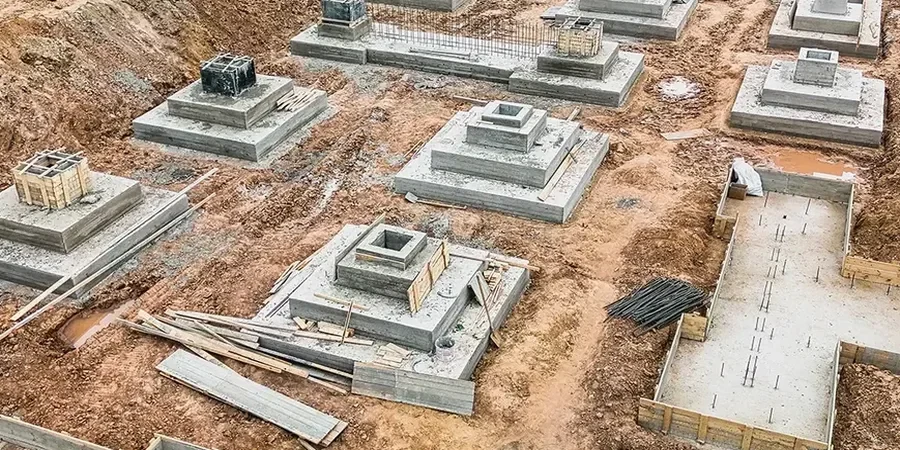
Windsor sits on a sequence of soft glacial clays deposited by the Detroit River system, with bedrock typically beyond 25 meters depth. These saturated, low-shear-strength soils make shallow footings impractical for any structure with moderate column loads. The water table often sits just 1.5 to 2 meters below grade in the Riverside and Walkerville neighborhoods. Our work starts with a thorough CPT test to map the stratigraphy continuously, identifying the competent bearing layer where pile tips will seat. We then apply NBCC 2020 load combinations and CSA A23.3 provisions for concrete pile design, factoring in the city’s frost penetration depth of 1.2 meters. What we see repeatedly across projects from Sandwich to East Windsor is that pile design must account for downdrag forces from consolidating clay — a condition you cannot ignore here.
In Windsor's Detroit River clays, the governing failure mode is rarely end-bearing — it is the accumulated downdrag that surprises engineers unfamiliar with the basin’s consolidation history.
Quick answers
How deep do piles need to go in Windsor to reach competent bearing?
In the downtown core and along the riverfront, competent bearing — typically dense glacial till or shale bedrock — is usually found between 22 and 32 meters. Shallower bearing may exist in South Windsor where the till rises, but we always verify with CPT soundings before finalizing pile tip elevations.
What is the typical cost range for a pile foundation design package in Windsor?
For a mid-rise residential or commercial building, the design package including site investigation interpretation, axial capacity calculations, group analysis, and construction drawings typically falls between CA$2,440 and CA$7,800 depending on the number of pile types and load cases.
Which building code governs pile design in Ontario?
The National Building Code of Canada 2020 (NBCC) sets structural loads and geotechnical requirements, while CSA A23.3 provides the concrete design provisions for cast-in-place piles and pile caps. For transportation structures, CSA S6 takes precedence.
Do you account for frost heave in pile design?
Yes. Windsor's frost depth per NBCC is 1.2 meters, so we specify a minimum pile embedment below that elevation. We also check the potential for adfreeze forces in the active frost zone and detail smooth sleeves or isolation where needed to prevent heave damage.