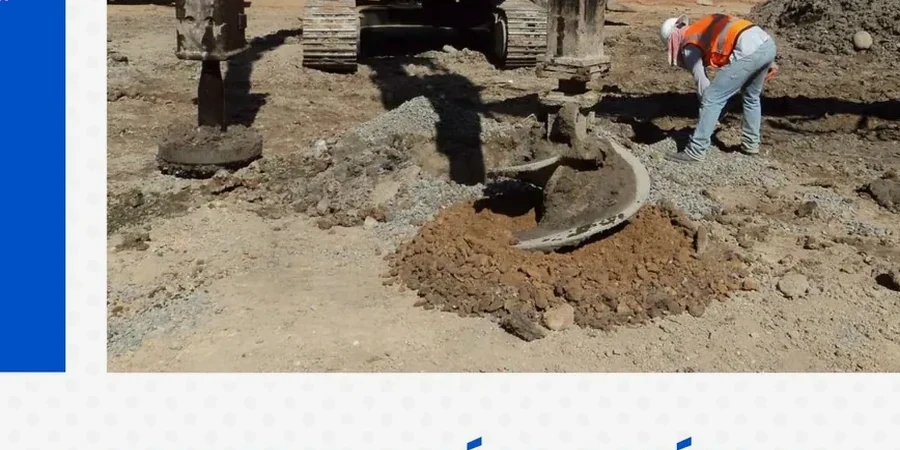
The soil profile in East Windsor and the soils under Sandwich Town tell two very different stories. Walkerville sits on relatively stiff glacial till that made its historic brick foundations straightforward. Cross over to the old riverfront neighborhoods near the Detroit River and you encounter the soft, compressible St. Clair clay plain—a deposit that can settle unpredictably under structural loads. This contrast defines every foundation decision in Windsor. The city sits at 42.2859° N latitude, right at the edge of a major glacial lake basin, where post-glacial clays reach depths exceeding 30 meters in some areas. A standard footing on these clays can settle for years. Stone column design changes that equation. Vibro-replacement columns displace the weak matrix and create composite ground with dramatically improved stiffness. For warehouses in the Walker Road industrial corridor or mid-rise structures near the university, the technique transforms problematic clay into buildable ground. Our technical group approaches each Windsor site by first reviewing the subsurface data from a CPT test to map the clay thickness and consistency, then calibrating the column geometry to the specific settlement tolerance of the structure.
On Windsor's St. Clair clay plain, a well-designed stone column grid can reduce post-construction settlement by over 60% compared to untreated footings.
Area-specific notes
A costly mistake we see in Windsor is specifying stone columns based on a generic design chart without running site-specific settlement analysis. The St. Clair clay varies significantly in plasticity and overconsolidation ratio across the city—what works in a stiff clay pocket near Devonshire Mall may fail in the softer lacustrine deposits closer to the river. Skipping a detailed review of the clay's consolidation parameters leads to under-designed grids. The columns get installed, the structure goes up, and six months later the floor slabs show cracks because the composite ground is still compressing. Another common error is ignoring the drainage function of the columns. In Windsor's low-permeability clays, the stone columns act as vertical drains, accelerating consolidation settlement during construction. If the design timeline does not account for this, the owner faces delays. The technical approach must include a coupled settlement-drainage analysis and a verification program using zone load tests.
Quick answers
How much does stone column design cost for a project in Windsor?
The design fee typically ranges from CA$1,830 to CA$6,670 depending on the project size, number of columns, and complexity of the soil profile. A small commercial lot with a single boring will be at the lower end. A multi-building site with variable clay thickness and strict settlement criteria will require more analysis and fall at the higher end.
What soil types in Windsor are suitable for stone columns?
Stone columns work best in soft to firm cohesive soils—exactly the profile found across much of Windsor's St. Clair clay plain. They are effective in clays and silty clays with undrained shear strengths between 15 and 50 kPa. The technique is not suitable for very sensitive clays that lose strength when vibrated, or for organic soils with high compressibility.
How long does the design process take?
A standard design package for a single structure site takes 2 to 3 weeks from receipt of the geotechnical report. This includes the settlement analysis, grid optimization, and preparation of the installation specification. Complex sites with multiple borings and variable stratigraphy may require an additional week for detailed cross-section analysis.
Does stone column installation disturb neighboring properties?
Vibro-replacement generates ground vibrations that can be felt nearby. In Windsor's residential neighborhoods like South Walkerville or Riverside, we assess the vibration impact radius and may recommend monitoring on adjacent properties. The installation method—top-feed or bottom-feed—also influences vibration levels and is selected based on site constraints.