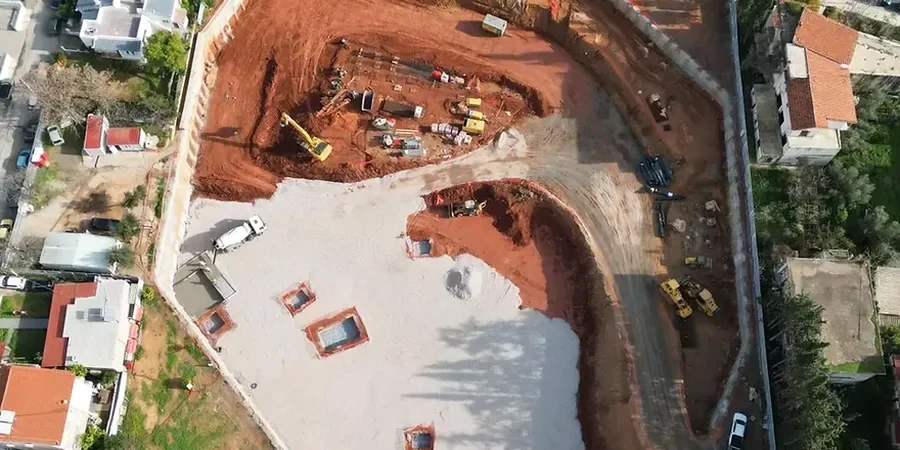
Windsor sits at an elevation of just 190 meters, with the Detroit River cutting through sensitive glacial clay deposits that have challenged excavation contractors since the Ambassador Bridge went up in 1929. Designing a deep excavation here means confronting soft, saturated silts and clays that lose strength fast when disturbed. We approach every project by mapping the stratigraphy against the NBCC 2020 requirements for temporary works, because a failure at 8 meters depth within city limits triggers consequences that go far beyond the jobsite. The interaction between groundwater drawdown and adjacent heritage foundations—think Walkerville’s century-old brick stock—demands a CPT test interpretation that resolves thin sand lenses most conventional boreholes miss entirely.
In Windsor’s Detroit River clays, base heave controls the excavation depth more than wall bending—check undrained bearing capacity first.
Our approach and scope
The most common mistake we see in Windsor is designing shoring based solely on SPT blow counts without accounting for the drained versus undrained behavior of the clay till. Contractors assume a stiff clay profile, then watch a cut slope creep for three days after a rainfall event. Our design process starts with defining the short-term undrained shear strength from field vane tests and CPT pore pressure dissipation data, then transitions to effective stress parameters for long-term wall embedment checks. We model staged excavation sequences—bench cuts, strut preloading, anchor lock-off stresses—using finite element software calibrated to local case histories. A typical cut in east Windsor might require soldier piles at 1.8-meter spacing with timber lagging, while a deeper excavation near the riverfront demands secant pile walls to control water inflow. The tieback design accounts for the low passive resistance in the Detroit River Group clays, often extending bond lengths beyond 12 meters to mobilize capacity in the underlying till.
Quick answers
How deep can you excavate in Windsor’s clay without tiebacks?
Cantilever soldier pile walls typically work up to 4 to 5 meters in the stiff clay till found across much of Windsor. Deeper than that, passive resistance is insufficient and either internal bracing or tieback anchors become necessary. Site-specific CPT data determines the exact limit.
What permits are required for a deep excavation in Windsor Ontario?
A building permit from the City of Windsor is required for shoring structures over 3 meters in height. The design must be sealed by a Professional Engineer licensed in Ontario. If dewatering discharge goes to the municipal storm sewer, a discharge permit from the Windsor Utilities Commission may also apply.
How long does geotechnical design for a deep excavation take?
A typical design package—including site investigation review, shoring wall design, anchorage calculations, and construction drawings—takes three to five weeks from receipt of complete geotechnical data. Complex groundwater control plans or 3D finite element modeling add one to two weeks.
What is the cost range for geotechnical design of a deep excavation in Windsor?
Design fees for a deep excavation project in Windsor typically range from CA$3,200 to CA$10,870 depending on excavation depth, shoring complexity, and whether instrumentation and monitoring plans are included. A 6-meter single-family lot excavation design falls at the lower end; a 15-meter commercial basement with tiebacks and dewatering design is at the upper end.
Do you provide construction-phase monitoring for deep excavations?
Yes. We specify inclinometer installations, survey monitoring points on adjacent structures, and piezometer readings at frequencies tied to excavation stage. Our team reviews the data weekly during active digging and provides threshold exceedance notifications per the observation method framework in the Canadian Foundation Engineering Manual.