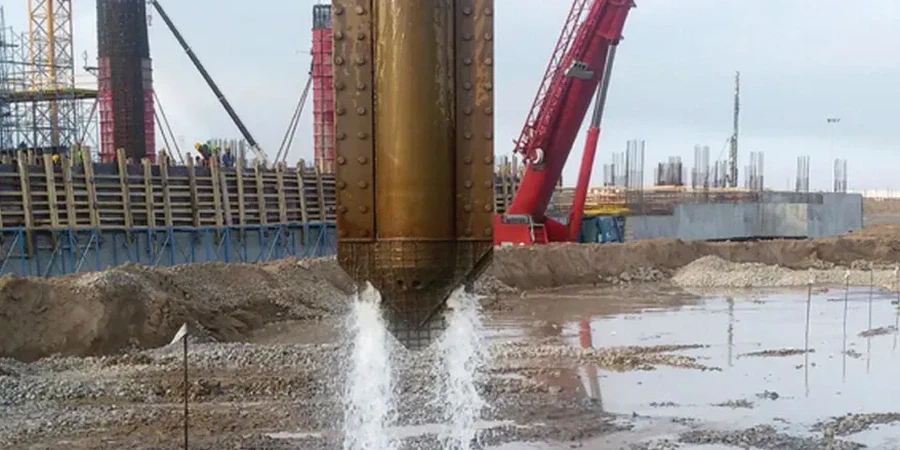
Contractors working in Windsor often underestimate how post-glacial loose sands respond to vibration. The city sits on a complex stratigraphy of glacial till and lacustrine deposits near the Detroit River, where uncontrolled fill layers can mask deep-seated weakness. A standard compaction plan based on Ottawa or Toronto background simply does not translate here. We have seen projects where uncorrected loose lenses led to differential settlement within the first year. Our approach to vibrocompaction design starts with a rigorous analysis of the grain-size distribution and in-situ density, because densifying Windsor’s heterogeneous subsurface requires more than a standard grid pattern. Before committing to a deep foundation scheme, many engineers in the region combine our vibrocompaction scope with a CPT test to map the exact depth of loose zones and confirm that the target relative density—typically 70% to 85%—is physically achievable given the local fines content.
In Windsor’s riverine geology, achieving 80% relative density below the water table demands a design that accounts for silt stringers—not just clean sand assumptions.
Area-specific notes
The vibroflot rig itself—a powerful electric or hydraulic vibrator suspended from a crawler crane—is what makes deep compaction possible, but it also defines the risk when design parameters are miscalibrated. In Windsor’s tight urban lots and near the riverfront, we operate rigs with variable frequency drives that allow us to adjust from 30 Hz down to 15 Hz, matching the resonant frequency of the surrounding soil. The biggest operational risk is creating a hydraulic fracture in a confined silt layer, which releases pore pressure uncontrollably and leaves a partially treated zone. We mitigate this by specifying a gradual power ramp-up and real-time monitoring of amperage. If the rig’s consumption drops abruptly, the operator knows the probe has hit a loose pocket that needs a longer hold time. Ignoring these signals leads to zones that pass a post-test but densify unevenly, creating a pattern of settlement bowls that crack grade beams and slabs within two years of occupancy.
Quick answers
What does vibrocompaction design cost for a typical lot in Windsor?
A site-specific vibrocompaction design package in Windsor generally ranges from CA$2,110 to CA$8,190, depending on the treatment depth, number of compaction points, and the extent of pre- and post-verification testing required. Projects with difficult access or high groundwater add complexity and may fall toward the upper end of that range.
How deep can vibrocompaction effectively treat Windsor’s loose soils?
Using modern electrically driven vibroflots, we can treat loose granular deposits down to about 30 meters below working grade. In Windsor, the practical limit is often dictated by the top of the competent till layer rather than the equipment. We run a CPT first to define the exact bottom of the loose zone.
Does vibrocompaction work in silty sands common along the Detroit River?
Vibrocompaction is most effective in soils with less than 12–15% passing the No. 200 sieve. In Windsor, we frequently encounter silty stringers. If the silt content is too high for pure vibrocompaction, we modify the design to a vibro-replacement approach using stone columns, which provides both compaction and drainage to prevent pore pressure buildup.