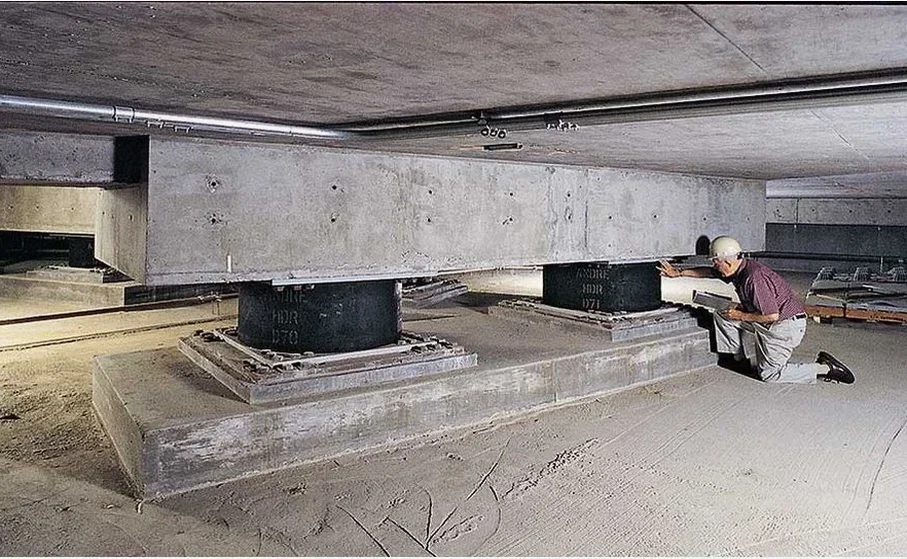
On Windsor's glaciolacustrine clays, the difference between a well-tuned isolator and a code-minimum design often shows up during a moderate Essex County tremor. We have seen too many structural schemes imported from rock sites in the Canadian Shield fall apart when they hit the deep soil amplification that defines the Windsor-Essex Parkway corridor. The 2020 edition of the National Building Code of Canada raised the seismic hazard in this part of Southwestern Ontario, and the soft clay profile—over 30 metres thick in sections of the Detroit River floodplain—demands a base isolation approach that starts with a site-specific seismic hazard assessment before any bearing selection. We run this coupling on every project because the spectral shape here does not match a generic Class E assumption. Getting the isolator properties right also depends on knowing what is happening below the foundation pad. We regularly pull SPT borings to 35 metres and run downhole shear wave velocity profiles to lock in the Site Class, then feed that into the nonlinear time-history model. The result is an isolation system that accounts for Windsor's unique long-period amplification rather than fighting it.
Isolating a building in Windsor without site-specific shear wave velocities is like tuning a suspension with the wrong spring rate—the math works on paper but fails in the field.
Our approach and scope
A mistake we see repeatedly in Windsor is treating base isolation as a structural-only problem and leaving the geotechnical investigation for the last week of design. On the east side near Ford City, old industrial fill and buried organic silt lenses create differential settlement risks that will distort an isolator plane if they are not mapped properly. We approach every isolation project by first establishing the dynamic soil properties through
seismic refraction surveys and crosshole testing, then running site response analysis in DEEPSOIL or equivalent software. The undrained shear strength of the St. Clair clay till typically sits between 50 and 120 kPa, but the secant shear modulus degrades fast above 0.1 percent strain—critical information for the isolator displacement demand. The system design we deliver includes the isolator type recommendation (lead-rubber, high-damping rubber, or friction pendulum), the effective period, the damping ratio, and the displacement demand under the 2 percent in 50-year hazard level. Each parameter is tied to a specific borehole log and a measured shear wave velocity, not a textbook default. For structures that require foundation isolation below a podium slab, we also verify the
mat foundation stiffness to ensure the isolation plane behaves as assumed in the structural model.
Area-specific notes
Windsor's urban fabric grew fast after the 1920s automotive boom, and a surprising number of institutional buildings sit on unengineered fill placed directly over the clay plain. When those structures come up for seismic retrofit, the base isolation option collides with a foundation system that was never meant to handle concentrated loads at the isolator pedestals. We have cored enough slabs in Walkerville to know the fill can contain brick rubble, cinders, and pockets of saturated sand that liquefy under short-duration shaking. The 2018 Amherstburg earthquake—a modest M3.6 event—was felt across the county and reminded owners that Windsor's seismic risk is real, even if it does not make headlines like Vancouver. Another risk is the groundwater regime. The water table across much of Windsor sits within 1.5 metres of grade, and seasonal fluctuations in the Little River and Turkey Creek watersheds change the effective stress profile. An isolator system that works in dry conditions can lose 30 percent of its restoring force if the foundation drainage fails and the subgrade softens. We require a liquefaction assessment on every isolation project where sand seams appear within the upper 20 metres, not because we expect a magnitude 7, but because even limited excess pore pressure shifts the site period enough to detune the isolation system.
Relevant standards
NBCC 2020 — Division B, Part 4 (Structural Design) and seismic provisions, CSA A23.3:2019 — Design of concrete structures, ASTM D7400 / D7400M — Standard Test Methods for Downhole Seismic Testing, CHBDC CAN/CSA-S6-19 — Canadian Highway Bridge Design Code (for bridge isolation), FEMA 356 / ASCE 41 — referenced for isolation retrofit criteria
Quick answers
Does base isolation make sense for low to mid-rise buildings in Windsor, or is it only for high-rises?
It depends on the performance objective and the soil profile. We have designed isolation systems for three-storey emergency response facilities in Windsor where the combination of deep clay amplification and post-disaster functionality requirements justified the cost. The NBCC 2020 allows a base-isolated structure to be designed for lower seismic forces than a fixed-base equivalent, but the real value in Windsor's soil conditions is the reduction in interstory drift and non-structural damage. For a typical four-storey office on a Site Class E profile, the isolator displacement demand often falls between 250 and 350 mm, which is manageable with a standard moat detail. The decision should be based on a site-specific cost-benefit analysis that includes the geotechnical investigation, not a rule of thumb about building height.
What is the typical cost range for base isolation design services on a Windsor project?
For a mid-rise institutional or commercial building in Windsor, the geotechnical investigation, site response analysis, and isolation system preliminary design typically range from CA$6,220 to CA$12,910, depending on the number of boreholes, the depth of the shear wave velocity profiling, and the complexity of the nonlinear time-history analysis. This does not include the isolator hardware procurement or the structural peer review, which are separate line items. The investigation scope is driven by the site area and the soil variability—a site near the Detroit River with 35-metre clay depths requires more testing than a shallow till site in South Windsor.
How do you verify that the isolators will perform as designed once they are installed?
We specify prototype and production testing programs in accordance with CSA and ISO standards for seismic isolation bearings. Before installation, the manufacturer tests full-scale isolators under the design axial load and the displacement demand we derived from the site response analysis. During construction, we monitor the plinth elevation and levelness with precise surveying, because a tilted isolator changes the restoring force. After installation, we recommend a baseline dynamic test of the isolated structure to confirm the global period matches the design model. In Windsor's clay, we also require piezometer monitoring around the foundation for the first year to confirm that groundwater conditions did not change during construction and soften the subgrade under the isolation plane.