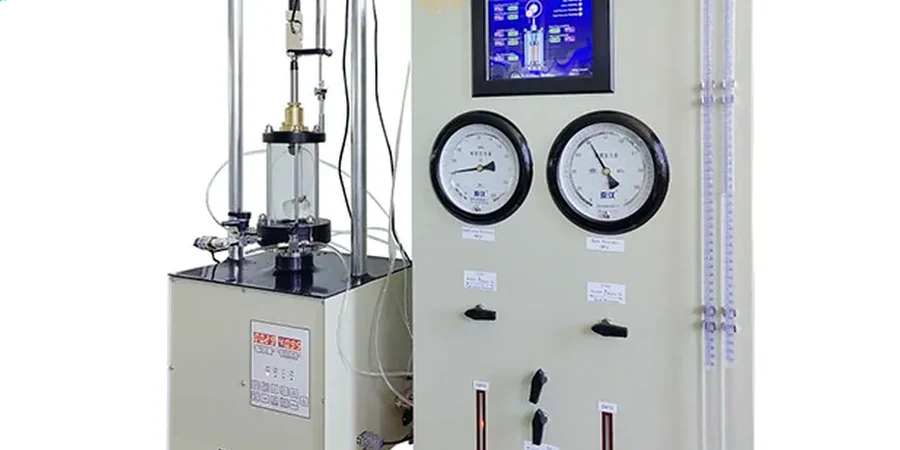
Windsor sits at an elevation of just 190 meters above sea level, perched on a thick sequence of glaciolacustrine clays deposited by ancient Lake Whittlesey. With a metropolitan population approaching 350,000, the city's expansion along the Detroit River corridor and into Tecumseh and LaSalle consistently encounters these sensitive, low-permeability soils. Designing safe foundations or shoring systems in Windsor demands more than index properties: you need the effective stress parameters that only a properly executed triaxial test can deliver. Our laboratory provides consolidated-undrained (CU) and consolidated-drained (CD) triaxial testing under ASTM D4767 and D7181, giving geotechnical engineers in Windsor the reliable c' and φ' values required to model soil behavior under the complex loading conditions typical of the region's deep clay profile. When site conditions suggest potential instability, we often recommend integrating the slope stability analysis to correlate the shear strength envelope with actual failure mechanisms observed in Essex County excavations.
A consolidated-undrained triaxial test on Windsor clay typically reveals an effective friction angle between 24° and 30°, with a cohesion intercept that can drop below 5 kPa at high plasticity—critical data for any excavation support design along the Detroit River.
Our approach and scope
The seasonal moisture cycles of southwestern Ontario, with wet springs saturating the Windsor clay and dry summers inducing desiccation cracks near the surface, create a dual challenge: the same formation can behave as a stiff overconsolidated material at shallow depth and a normally consolidated soft clay at depth. Triaxial testing is the only laboratory method that can replicate these in-situ stress states. We mount undisturbed Shelby tube samples from Windsor sites in a triaxial cell, apply back-pressure saturation to achieve Skempton B-values above 0.95, then consolidate the specimen to the estimated field effective stress before shearing at a controlled strain rate of 0.05 to 0.1% per minute. The test yields the complete Mohr-Coulomb failure envelope, including effective cohesion intercept and friction angle, plus pore pressure response for undrained conditions. For granular layers encountered in the Talbot Road area or near the airport, we complement the triaxial program with a
grain size analysis to correlate the drained strength with particle gradation and relative density.
The data package includes the stress-strain curve, p'-q' stress path, and pore pressure evolution, all referenced to the specimen's measured density and moisture content. Results are interpreted according to the multi-stage technique when sample availability is limited, which is common in Windsor's urban infill projects where borehole access is constrained by nearby structures.
Area-specific notes
Windsor's urban fabric expanded rapidly during the 1920s automotive boom, with many industrial buildings and waterfront structures erected on shallow footings bearing directly on the clay crust. Over the following century, regional groundwater drawdown and changes in the Detroit River level have altered the pore pressure regime beneath these foundations. The result is a long-term consolidation process that can reduce the effective stress margin calculated decades ago. A triaxial test on a single undisturbed sample from a critical depth can reveal whether the soil's undrained shear strength still meets the NBCC 2015 load combination requirements, or if a deep excavation support design needs to account for a lower shear strength than originally assumed. In Windsor's east end, where the clay transitions to siltier facies, the failure mode can shift from plastic flow to brittle rupture; the triaxial test captures this transition through the strain-softening behavior visible in the post-peak portion of the stress-strain curve, allowing the geotechnical engineer to select an appropriate residual strength for progressive failure analysis.
Relevant standards
ASTM D4767-11 (2020): Standard Test Method for Consolidated Undrained Triaxial Compression Test for Cohesive Soils, ASTM D7181-20: Standard Test Method for Consolidated Drained Triaxial Compression Test for Soils, ASTM D2850-15: Standard Test Method for Unconsolidated-Undrained Triaxial Compression Test on Cohesive Soils, NBCC 2015: National Building Code of Canada, Division B, Part 4, Section 4.2.4 (Foundation Design), CSA A23.3-14: Design of Concrete Structures (references to geotechnical parameters)
Quick answers
What is the typical cost of a triaxial test program in Windsor?
A standard three-specimen CU triaxial test program in Windsor typically ranges from CA$2,720 to CA$3,380, depending on the number of confining pressures, specimen size, and whether multi-stage techniques are employed. This includes back-pressure saturation, consolidation, shearing, and the complete interpreted report with Mohr-Coulomb parameters. Expedited turnaround may affect the final figure.
How long does it take to get triaxial test results for a Windsor project?
A CU triaxial test program on Windsor clay generally requires 10 to 14 business days from sample receipt to final report. The consolidation phase alone can take 24 to 72 hours depending on the clay's hydraulic conductivity. CD tests require 5 to 7 days per specimen due to the slow strain rate needed for pore pressure dissipation. We always verify sample condition upon arrival and can supply preliminary Su values from UU tests within 48 hours for urgent foundation design decisions.
How many specimens are needed for a reliable triaxial shear strength envelope?
ASTM D4767 requires a minimum of three specimens, each sheared at a different effective confining pressure, to define the Mohr-Coulomb failure envelope. For Windsor's sensitive clay, we often recommend a fourth specimen or the use of the multi-stage technique on a single sample when undisturbed Shelby tube recovery is limited, though the single-stage method on multiple samples remains the most reliable approach. The confining stress range is selected to bracket the in-situ effective stress at the sampling depth.
Can you perform triaxial tests on the Windsor clay if the samples show signs of disturbance?
Sample disturbance is a common concern in Windsor's sensitive lacustrine clays. We evaluate every Shelby tube upon arrival and document the degree of disturbance according to the criteria in ASTM D4220. For moderately disturbed samples, we can apply a reconsolidation procedure to restore the in-situ effective stress state before shearing, though we always flag the results with a sample quality note. Severely disturbed samples are rejected because reliable c' and φ' parameters cannot be recovered from remolded soil.