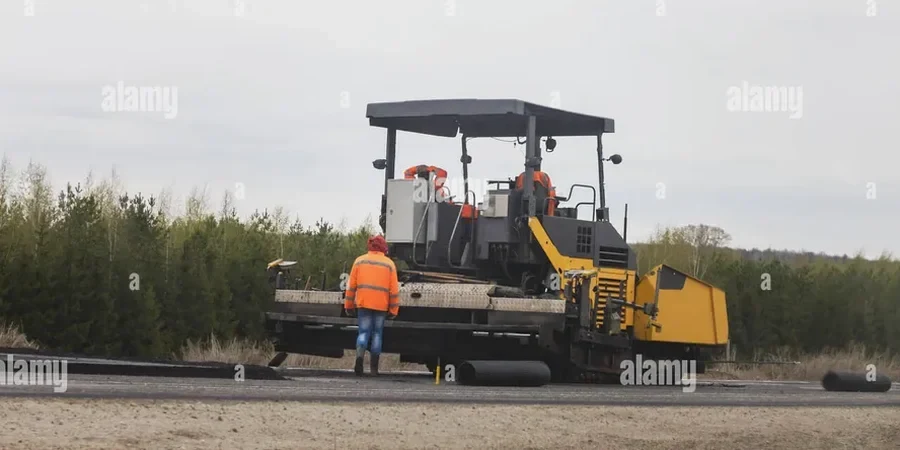
The Detroit River floodplain shapes pavement performance across Windsor more than most engineers admit. Heavy lacustrine clays and a water table that sits barely a meter below grade in parts of Sandwich and Riverside mean subgrade support is never a given. We see rutting appear within three seasons when the structural number is calculated without accounting for seasonal moisture fluctuation. That is why our flexible pavement design process starts with a field investigation calibrated to Essex County geology—not a textbook. Before committing to a granular base thickness, we often verify shear strength with an in-situ permeability test to confirm drainage capacity beneath the frost line. Windsor's freeze-thaw cycles, averaging 80 per winter, punish poorly drained bases faster than many contractors expect. The pavement structure has to breathe, or it fails.
A flexible pavement in Windsor lives or dies by its drainage detail—not by its asphalt thickness.
Our approach and scope
The native soils here are predominantly glaciolacustrine silty clays—highly plastic, frost-susceptible, and notoriously variable over short distances. A borehole log from South Windsor can look completely different from one taken near the airport, even 300 meters apart. Our flexible pavement design accounts for this by building subgrade resilient modulus profiles from CBR, DCP, and falling weight deflectometer data rather than relying on a single assumed value. We work directly with OPSS 501 granular base specifications and model traffic loading using MTO's cumulative ESAL projections, not generic AASHTO defaults. For arterial roads and industrial yards, the section typically requires a minimum 150 mm of Granular A over 300 mm of Granular B Type II, with subdrains at the low side of the crossfall. The binder course specification—usually Superpave 12.5 FC1—is chosen for the chloride exposure common along Walker Road and the EC Row corridor. Windsor's flat topography means positive drainage is always a design challenge; we use 2.5% minimum crossfall and frequent catch basins to prevent water from sitting on the surface and infiltrating the base.
Area-specific notes
In Windsor-Essex, the most common failure mode we encounter in flexible pavements is not structural cracking from overload—it's subgrade softening along the outer wheel path. Spring thaw saturates the shoulder gravel, water migrates into the base course, and the pavement edge starts pumping fines through the asphalt. Once the base loses confinement, the surface layer fatigues within a single season. A second risk, especially on industrial lots near the salt mines and trucking depots, is underestimating stationary and slow-moving loads. A loaded trailer sitting on hot asphalt at 35°C deforms the surface faster than the traffic model predicts. Our designs address this with polymer-modified binder in high-static-load zones. We also see reflection cracking where old composite pavements are simply overlaid without a crack-relief interlayer; in Windsor's clay soils, differential movement across the joint will telegraph through within two winters.
Quick answers
What is the typical cost range for a flexible pavement design package in Windsor?
Design fees generally range from CA$2,220 to CA$8,220 depending on the project length, traffic classification, and whether FWD testing is required. A simple parking lot design sits at the lower end; an arterial road with full MTO documentation and construction-phase testing sits at the upper end.
How do Windsor's clay soils affect pavement life?
The local glaciolacustrine clays are highly moisture-sensitive and frost-susceptible. Without adequate drainage and a proper granular base, subgrade strength drops sharply during spring thaw, leading to rutting and fatigue cracking. We specify geotextile separators, subdrains, and minimum base thicknesses to isolate the pavement structure from these seasonal changes.
Which asphalt mix performs best with the salt exposure on Windsor roads?
We typically specify Superpave 12.5 FC1 for the surface course, which provides good resistance to chloride-induced stripping and thermal cracking. For industrial areas with standing loads, a polymer-modified PG 70-28 binder is often worth the premium.