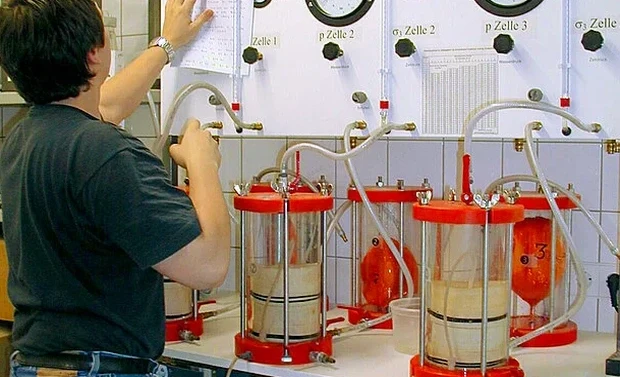
The glacial lake plain deposits underlying Windsor present a distinct geotechnical profile: silty clays and clayey silts with occasional sand lenses, deposited when glacial Lake Warren covered this region some 12,000 years ago. With a population exceeding 230,000 and a humid continental climate producing freeze-thaw cycles that penetrate up to 1.2 metres, the city's pavement structures face seasonal moisture fluctuations that directly impact subgrade bearing capacity. A laboratory CBR test quantifies this capacity under controlled moisture and density conditions. The team has processed hundreds of disturbed samples from sites across Essex County—from the heavy clay corridors near Walker Road to the silty transition zones approaching the Detroit River waterfront. When roadway rehabilitation or new commercial parking areas require MTO-compliant design, we pair the laboratory CBR test with field sand cone density verification to confirm that compaction specifications have been met before asphalt placement.
A soaked CBR value below 3% on Windsor's silty clays typically demands subgrade replacement or chemical stabilization before any pavement structure is placed.
Quick answers
How much does a laboratory CBR test cost in Windsor?
A standard three-point laboratory CBR test (soaked) typically ranges from CA$160 to CA$250 per sample, depending on whether the Proctor compaction curve is already available or must be determined concurrently. Projects requiring multiple samples for spatial variability assessment benefit from reduced per-unit pricing.
How many CBR samples are needed for a typical Windsor commercial site?
For a commercial development under one hectare on Windsor's relatively uniform clay plain, a minimum of three to four CBR samples from distinct borehole or test pit locations is standard practice. Sites crossing mapped geological boundaries—for example, transitioning from clay plain to sandy near-shore deposits—require additional samples to characterize each soil unit independently.
What is the difference between a soaked and unsoaked CBR test?
The soaked CBR test submerges the compacted specimen in water for 96 hours before penetration testing, simulating the worst-case saturated condition that occurs during spring thaw in Windsor. The unsoaked test measures strength at the compaction moisture content. MTO and most municipal specifications in Ontario require soaked CBR values for pavement design because they represent the critical long-term condition.
Can CBR test results be used directly for concrete pavement design?
While the laboratory CBR test was developed primarily for flexible pavement design, the soaked CBR value provides a useful index of subgrade support quality that can inform the modulus of subgrade reaction (k-value) estimation for rigid pavement. However, the correlation is approximate. For critical rigid pavement projects, plate load testing or back-calculation from deflection data is preferred.
How long does a laboratory CBR test take from sample submission to report?
The standard turnaround is five to seven business days. The 96-hour soaking period mandated by ASTM D1883 occupies four full days; the remaining time covers compaction curve determination, specimen preparation, penetration testing, and data reduction. Expedited service with a 72-hour turnaround is available when project schedules require it.